
What is integrated RCM?
Integrated revenue cycle management means billing lives in the same system as clinical documentation, so claims are generated from the services already in the record instead of being re-entered into a separate billing platform. The practical effects show up at specific moments in a biller's day: before the appointment, at claim creation, when the remittance comes back, and when a secondary payer is involved. This page walks through each.
Can eligibility checks run before appointments?
In Ritten, yes, automatically. You can schedule eligibility checks to run a set number of days before upcoming appointments, filtered to the clients and payers you care about, and coverage is checked by policy rank, so secondary policies are verified alongside primary. Staff stop running manual insurance checks visit by visit, and inactive coverage surfaces before the client is seen rather than after the claim denies.
How do claims get created without
manual coding?
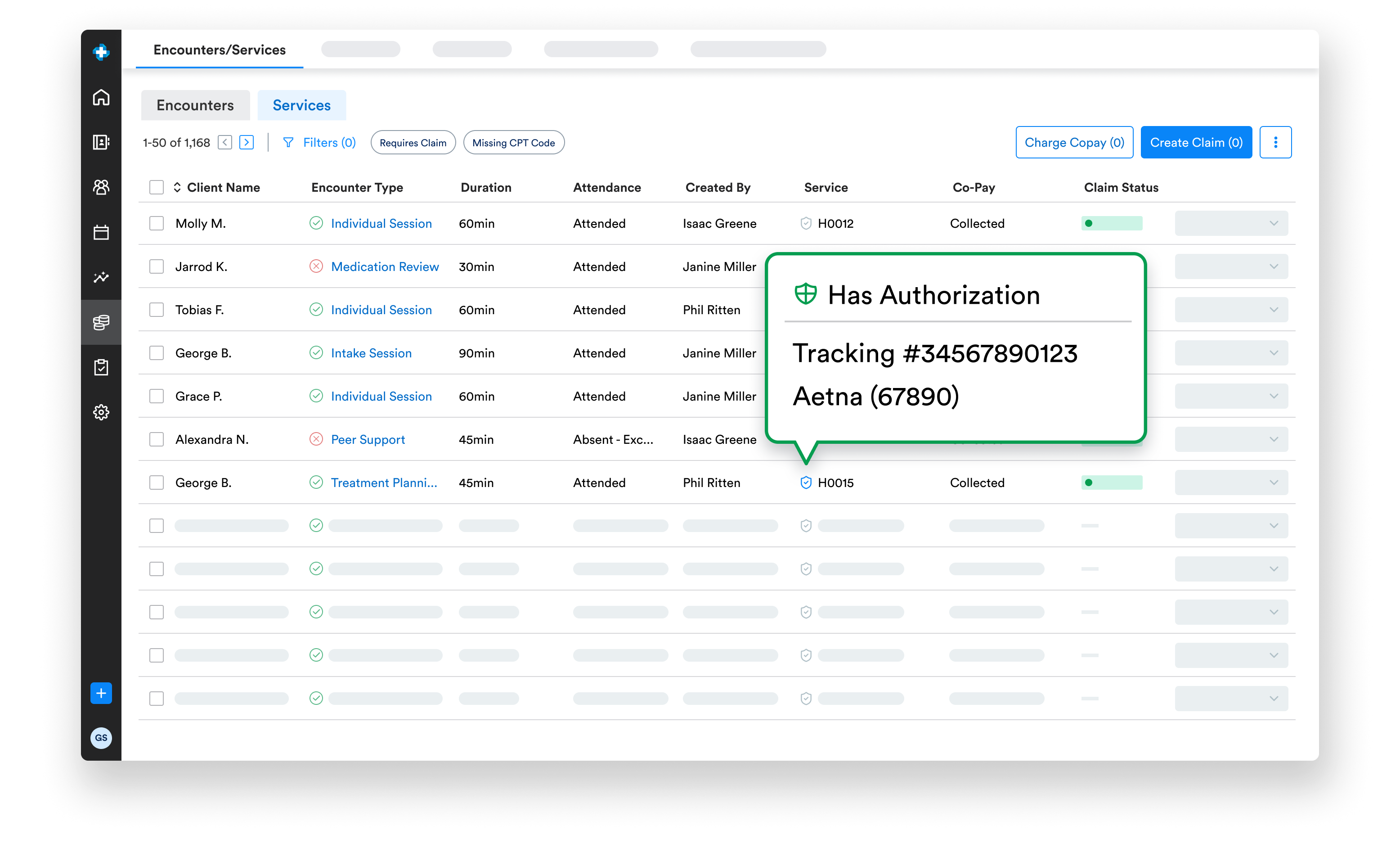
Billing rules translate clinical activity into claims. When a clinician starts a session, the system evaluates the service type, program and level of care, payer, duration, and provider, and codes the service accordingly: CPT code, units and rounding, modifiers, and place-of-service. Rules handle the edge cases that dominate behavioral health billing, including rendering provider logic for pre-licensed clinicians billed under supervisors, payer-specific provider and modifier changes, telehealth billed differently than in-person, and add-on codes for complex sessions. Clinicians never touch codes; they run the service, and the claim builds itself.
What stops a bad claim
from going out?
Services are held as pre-claims until they are ready. Hard blocks prevent claim creation when required information is missing from the chart, such as demographics or a diagnosis, and required documentation and signatures can gate billing. Anything that fails to match a billing rule is surfaced for audit rather than slipping through, and incomplete claims are flagged with the missing fields highlighted before submission. Denial prevention starts in the chart, not in a rework queue.
.png)
What happens when the remittance comes back?
Electronic remittances flow back attached to the claims they were submitted on. Auto-posting applies the adjudication: paid claims that balance are closed, contractual adjustments such as CO45 post as insurance adjustments automatically rather than manual write-offs, client responsibility routes to a balance due that can flow to statements, and anything unusual is set aside on hold for review. Every payment, adjustment, and prior payment including copays stacks against the claim, so the full transaction history lives in one place.
How are secondary claims handled?
When a primary payment leaves a balance and the client has secondary coverage, the claim is marked pending secondary during posting. Converting it flips the payer order and carries the primary adjudication onto the claim automatically, individually or in bulk, with conversion rules applying any payer-specific changes such as a different rendering provider NPI. Programs serving clients with Medicaid as secondary spend their time on exceptions instead of re-keying every crossover.
What about reporting?
AR aging in standard buckets, payments and adjustments broken out by type, and claim and client balances are available out of the box, with drill-down to the underlying claims and export. Reporting runs on your full history, so an insurance aging report for a custom date range is a query, not a support ticket. For anything custom, Ritten's Data Studio builds reports and dashboards from natural language requests.
Can you keep a third-party biller and still benefit?
Yes. Many facilities work with an outside billing partner, and the documentation-to-billing linkage still pays off: the biller receives complete, scrubbed claim data, and your team keeps visibility into documentation gaps before they become denials. If you work with a billing partner, evaluate how the platform supports that relationship rather than replacing it.
Frequently Asked Questions
Still have questions about our behavioral health software? Email us at hello@ritten.io
Ritten is built for HIPAA-regulated care and behavioral health confidentiality needs, including 42 CFR Part 2. It includes role-based access controls and audit logs, and it can limit who can view sensitive records. We can share security documentation and help you configure settings to match your policies.
To request a demo, visit the Ritten demo page and provide basic information about your organization and workflows. For pricing, implementation scope, and integration requirements, Ritten typically reviews your number of programs, levels of care, users, and billing complexity to propose an appropriate subscription and onboarding plan.
Ritten is web-based. Staff sign in through a modern browser (often Chrome) on a computer or tablet. There’s no desktop software to install and no servers for your team to maintain.
Implementation timing depends on your program size, workflow complexity, and any data you want to migrate. After kickoff, we’ll build a project plan with clear steps for setup, training, and go-live—aligned to your timeline.
Implementation typically includes structured onboarding and role-based training (for example: admissions, clinicians, nursing, utilization review, billing, and leadership). After go-live, teams usually reach support through the support portal or email for questions and help. If something is blocking care or billing, call that out so it can be prioritized.
Integration options depend on your workflow and vendors. Common areas include e-prescribing, labs, eligibility/billing, clearinghouse workflows, and telehealth links. During evaluation, we’ll confirm the integrations you need and the best way to connect them (native integrations, exports, or API).
Ritten is a cloud-based behavioral health EMR and practice-management platform. It brings admissions, scheduling, clinical charting, outcomes tracking, revenue cycle workflows, and AI documentation tools into one system.
Ritten is designed for behavioral health organizations across levels of care, including inpatient, residential, partial hospitalization (PHP), intensive outpatient (IOP), and outpatient programs. Typical use cases include acute mental health, addiction treatment, eating disorder programs, and integrated behavioral health teams that need multidisciplinary documentation, scheduling, and billing workflows in one EMR.